I Got An Upper Bleph
Friends are talking about facelifts over dinner. Upper blephs are showing up all over Instagram. Someone you know gets one and suddenly looks ten years younger without looking dramatically different. Procedures that once felt secretive are now showing up in dinner conversations, group chats, Instagram saves, and the kind of casual “wait, who did she go to?” texts that start innocently and end with someone sending a surgeon’s entire tagged-photo history.
Part of this shift feels refreshing. I would much rather hear a woman say she had an upper bleph than watch another celebrity imply that her impossibly refreshed face is the result of olive oil, sleep, and good genes. We are living in the era of collective beauty forensics. Is Anne Hathaway that snatched because of a very tight ponytail, or does an extremely talented surgeon deserve some credit? Does Emma Stone look more lifted, or is that just lighting, bone structure, and Hollywood sorcery? How does Michelle Pfeiffer still look like Michelle Pfeiffer forty years later? The point is not really whether any of these women have had anything done. The point is that we are watching women age differently than previous generations did, and many of us are trying to figure out where we fit inside that reality.
This is an especially layered conversation for women who also care about wellness, spirituality, health, and self-development. We are regulating our nervous systems, healing our inner child, optimizing our hormones, filtering our water, avoiding toxins, and learning to love the face in the mirror. I believe in all of that. Deeply. I also believe that looking good can be part of feeling good, especially when it is rooted in your own sense of confidence rather than someone else’s approval. I can care about my vessel, my sleep, my inflammation, my emotional patterns, my career, my purpose, and my eyelids.
I have always had hooded eyes. They were not extremely heavy, but they were part of my face, and they were always slightly uneven. I started getting Botox around the eye area relatively young, and for a while, it gave me enough lift and balance to make everything feel manageable. As I got older, though, the hooding changed. The asymmetry became more noticeable. One eye seemed to age differently than the other, and Botox could no longer do the same heavy lifting.
If you have ever become fixated on one feature of your face, you know how quietly the obsession begins. At first, it is just something you notice. Then it becomes something you notice in every photo. Then you start comparing old pictures of yourself like a detective who has unfortunately been assigned her own face as a case file. You zoom in. You tilt your head. You convince yourself that you are being objective, which is usually the first sign that objectivity has left the building.
Around the same time, upper blephs seemed to be everywhere. Women were sharing their results. Surgeons were posting transformations. Influencers were documenting recovery. People were talking about how a relatively simple procedure took ten or twenty years off their face. I had hooded eyes, the hooding was changing, and there was a surgery designed to address exactly that. In my mind, the math felt fairly simple.
So I did what I thought was responsible. I researched doctors. I followed surgeons on Instagram. I looked at before-and-afters. I worked with a beauty broker. I asked questions. I booked the surgery. Now, almost a year later, I can say that I don’t regret the upper bleph. It did make a noticeable difference. What surprised me was not getting the surgery itself but that I didn't anticipate was how much uncertainty would follow.
A few months after surgery, I became convinced something was wrong. One eye looked noticeably more open than the other, and what followed was a whirlwind of Google searches, specialist consultations, second opinions, and more anxiety than I ever expected from a procedure that is often presented as relatively straightforward. Between a previously undiagnosed ptosis, a thyroid imbalance, inflammation, Botox, and Sculptra, it turned out there were several factors influencing what I was seeing, none of which I understood before surgery.
Thankfully, everything worked out. My eyes eventually settled, I found an excellent oculoplastic surgeon who helped me understand what was happening, and I never ended up needing the corrective procedure I spent months worrying about.
But the experience taught me something important: cosmetic procedures may be common, but they are rarely as simple as they appear. Looking back, there are several things I would do differently if I could go back and have a conversation with the version of myself who was sitting in that consultation room for the first time.
My Biggest Mistake Was Not Choosing An Oculoplastic Surgeon
If I could go back and change one thing about my experience, this would be at the very top of the list. At the time, I thought I was dealing with hooded eyes. I knew my eyes were slightly asymmetrical, but I assumed that asymmetry was simply part of the hooding. I had worn glasses and contacts since I was a child. I'd had LASIK. I dealt with occasional dryness. My eyes had always required a little more maintenance and attention than the average person's, but I never considered that any of those things might matter when it came to an upper bleph.
Looking back, that assumption seems a little ridiculous. What I didn't understand is that eyelids are not just cosmetic. They are functional, delicate, and incredibly specific to your anatomy. We tend to think of an upper bleph as a fairly straightforward procedure. There is extra skin. The extra skin gets removed. Problem solved. But the eyes are far more nuanced than that, and that's where an oculoplastic surgeon can bring a very different perspective than a traditional plastic surgeon.
One of the biggest things I learned after surgery was that I had a mild ptosis, which means one eyelid sits lower than the other. Looking back through old photos, I can see it was there all along. At the time, though, I didn't have the language for it. I simply thought my eyes were uneven because of the hooding, and I assumed that if there was anything important about my anatomy that could influence the outcome, it would have been identified during the consultation process with my plastic surgeon.
What I didn't realize is that an upper bleph removes excess skin. It does not correct a true ptosis. Had I known what I was actually dealing with, I could have had a completely different conversation before surgery about whether it made sense to address both issues at the same time. My plastic surgeon did not clock my ptsosis and basically brushed me off after surgery saying I’d have to see a specialist to correct it.
This is where I think an oculoplastic surgeon would have changed my experience. Their entire specialty revolves around the anatomy and function of the eyes and eyelids. A regular plastic surgeon may be excellent at performing upper blephs, but if you've had asymmetry, dry eyes, long-term contact lens use, LASIK, or anything else that makes your eyes a little less straightforward, that additional expertise can be incredibly valuable.
I don't think every woman considering an upper bleph needs to run out and find an oculoplastic surgeon. But I do think that if you've ever had ongoing issues with your eyes, if you've always felt like one eye was different from the other, or if there is anything about your eye health that has followed you throughout your life, it's worth getting that opinion before making a decision.
At best, you spend an extra consultation fee. At worst, you avoid months of confusion, second-guessing, and trying to figure out whether what you're seeing is healing, anatomy, or something that should have been addressed differently from the start.
Do Not Choose an Instagram-Famous Surgeon Just Because They Are Instagram-Famous
This one is humbling to admit because I like to think of myself as someone who is not easily influenced by social media. I research. I ask questions. I consider myself thoughtful. I am not usually the person who sees a few beautiful women on Instagram and immediately assumes their doctor must be my doctor, except apparently, sometimes I am exactly that person.
Social proof works. That is why it is called social proof and not “information you are too smart to be affected by.” We live in an era where certain surgeons have become celebrities in their own right. Their feeds are polished. Their before-and-afters are compelling. Their patients are gorgeous. Their waiting rooms seem filled with influencers, founders, models, and women whose faces suggest they have excellent genetics and someone very skilled on speed dial.
It becomes easy to interpret visibility as validation. If enough beautiful women trust someone with their faces, surely that person must be the safest choice. The problem is that popularity and compatibility are not the same thing. A surgeon can be talented and still not be the right surgeon for you. A doctor can have an impressive social media presence and still not make you feel particularly seen, heard, or cared for.
Looking back, I ignored my instincts because the surgeon’s reputation carried so much weight in my mind. The bedside manner was not great, but I talked myself out of caring because I kept thinking, if he did her, why couldn’t he do me? A sentence that has likely led women into questionable relationships, apartments, and aesthetic decisions since the beginning of time.
What I understand now is that when a surgeon has built a business around influencers and visibility, that visibility matters. It does not make them bad, and it certainly does not mean they are not talented. But it does mean their practice may be oriented around a certain kind of client, exposure, and exchange. The type of service an A-list celebrity or influencer receives may not be the same experience you receive when you walk in as a regular patient paying out of pocket and hoping to be treated with the same care.
I think I assumed that because certain women received a particular level of attention, communication, and care, I would too. The reality is that I was not their influencer client. I was their patient. Cosmetic surgery requires an enormous amount of trust. You are not buying a serum. You are not booking a blowout. You are paying someone to alter a feature you will look at every single day. Credentials matter. Results matter. Experience matters. But how you feel in the room matters too. If something feels rushed, dismissive, transactional, or simply off, do not override that feeling because the surgeon has a beautiful Instagram feed. Your gut is allowed to participate.
Hiring A Beauty Broker Is Helpful But Not a Guarantee of Results
One of the smartest things I thought I did was hire a beauty broker. To be clear, I still think beauty brokers can be incredibly valuable. They know the landscape. They understand the doctors. They can help narrow the field, save research time, and point you toward surgeons you may not have found on your own. If I were considering a larger procedure in the future, I would absolutely consider working with one again.
The mistake was assuming that hiring a beauty broker made the process fail-proof. I felt like I had an official sign-off, which made me relax more than I should have. But a beauty broker can give recommendations; they cannot guarantee outcomes. They cannot predict every complication, healing variable, anatomical nuance, or emotional reaction you may have after surgery. They also cannot replace the responsibility you still have to do your own research and ask your own questions.
In my case, the broker gave me two recommendations, and I chose the doctor who was more Instagram-famous. That was my decision. The broker also did not clock my ptosis or suggest that I see an oculoplastic surgeon first, which is part of why I now feel so strongly about getting that kind of specialized opinion for eye procedures. This is not about blame. It is about remembering that no third party, no matter how smart or connected, can be the golden ticket we sometimes want them to be.
There is something seductive about outsourcing trust. It feels efficient. It feels responsible. It feels like you have brought in an expert, so you can relax. But when it comes to your face, you cannot fully outsource your discernment. A recommendation is a starting point, not a conclusion. The broker can open the door, but you still have to decide whether you feel safe walking through it.
Get Multiple Consultations and Suck Up the Fees
Before surgery, multiple consultations felt unnecessary. I had a recommendation. I had a surgeon. I had looked at results. I thought I understood the procedure. Spending hundreds of dollars here and there to hear more opinions felt annoying and excessive. In hindsight, it would have been one of the smartest investments I could have made.
Every surgeon I saw after my bleph added something different to the conversation. One focused on ptosis. Another discussed orbital structure. Another mentioned thyroid function. Others had different perspectives on whether to wait, whether to correct, how to even things out, and what was simply part of healing. I wish I had gathered those perspectives before surgery instead of after.
The point of a consultation is not only to decide whether to book with that doctor. It is also to collect information. You are paying for knowledge, language, and perspective. You are learning how different experts see your face, what they notice, how they explain things, and whether you feel like they are entering into a partnership with you or simply moving you through a procedure they perform all the time.
If I could go back, I would schedule at least three consultations before choosing a surgeon. I only did one because I had the beauty broker and thought I was covered. I was not. The research is not separate from the surgery. The research is part of the surgery.
Get Your Blood Work and Make Sure Your Body Is Stable
One of the lessons I did not expect is how much the appearance of the eyes can be influenced by things that are not purely cosmetic. Before my upper bleph, I was focused on the hooding. That was the visible concern, so that became the entire story in my mind. What I did not fully appreciate is that the eyes can reflect a lot of what is happening internally.
I had some degree of ptosis for a long time, but there was also a period where one eye appeared more open than the other in a way I did not understand. I assumed it was all connected to hooding and aging. After seeing oculoplastic surgeons after the procedure, I learned there could be other factors involved. One sent me for lab work to rule out eye-related disorders, and through working with another practitioner, I realized my thyroid was also off. Once I started supporting it, the eye that had seemed more open softened and came closer to the other eye.
That was one of those moments where I realized how quickly I had turned something into a cosmetic problem without asking whether there were medical or inflammatory pieces contributing to it. Thyroid function, inflammation, hormones, fluid retention, autoimmune activity, and general health can all influence puffiness, lid position, and how the eyes appear.
This does not mean every asymmetry is caused by a health issue, but I would want my body in the most stable place possible before making decisions about my face. The face is not separate from the body, even though beauty culture often treats it that way. If something has recently changed around your eyes, it is worth asking why before rushing to correct it.
Hold Off on Botox, Sculptra, and Other Injectables
I also wish I had given my face more time to settle before adding anything else into the mix. Before an upper bleph, many surgeons want you off Botox for a period of time so they can see the natural position of your brows and lids. After surgery, you are told to wait a certain number of weeks before getting injectables again. By the time you are cleared, especially if you are used to regular Botox, you may feel very ready. I certainly did.
The moment I was cleared, I went back to my injector. I had gone months without Botox, I was still adjusting to my eyes, and I wanted to feel polished again. Around that time, I also tried Sculptra, which I had never done before. In theory, it made sense. I was already in a season of aesthetic upkeep, and I wanted to support the overall structure of my face. What I did not anticipate was how much harder it would become to understand what was actually happening.
After Botox and Sculptra, I experienced puffiness and inflammation that made it difficult to assess my upper bleph result clearly. My eyes were still healing. My face was reacting. Suddenly I was trying to determine what was swelling, what was Botox, what was Sculptra, what was ptosis, what was thyroid, and what was simply the normal evolution of healing. It was too much data and not enough clarity.
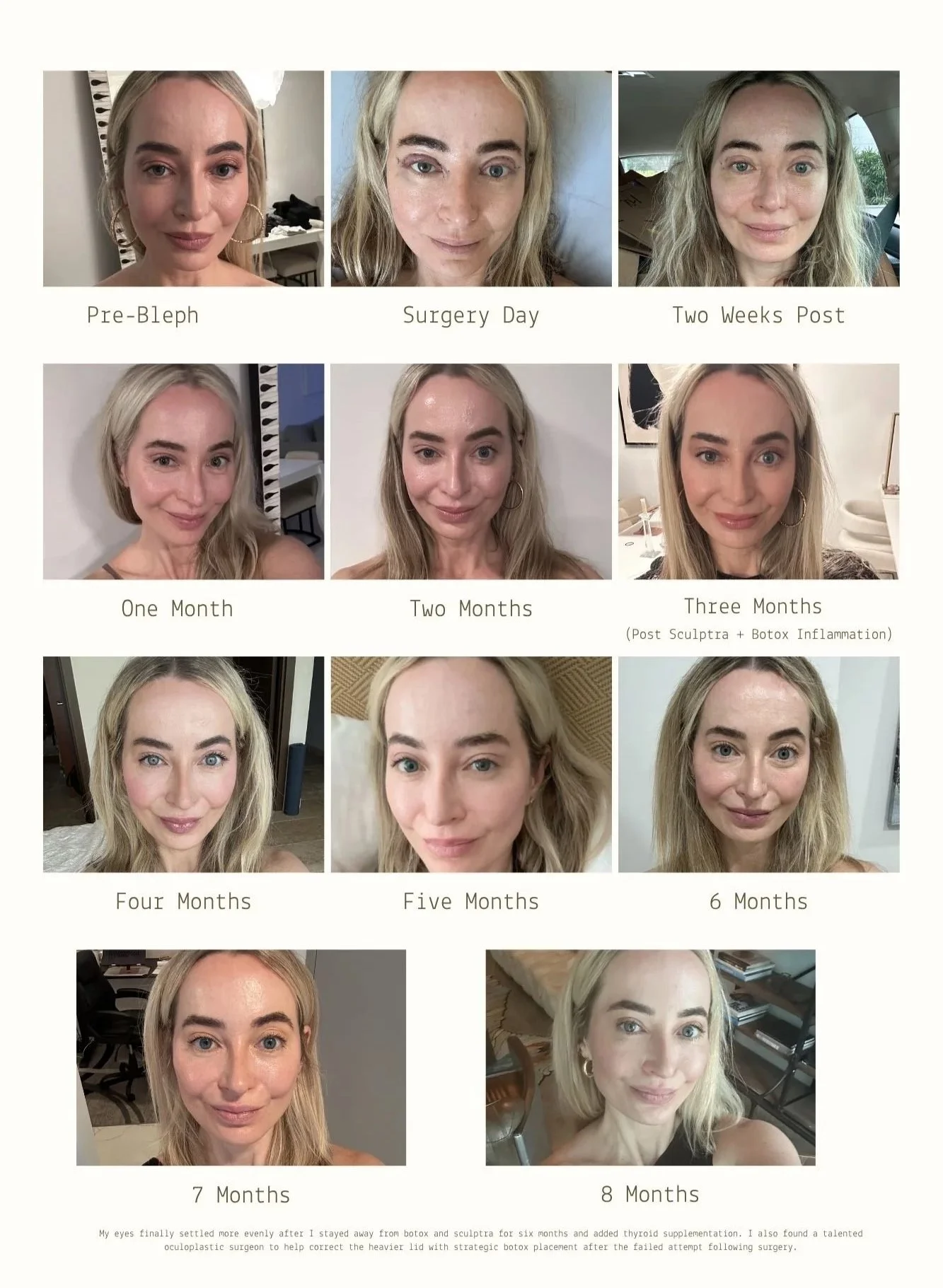
Once I waited a good six months for the Botox and Sculptra to wear off and my face to settle, I had a very different picture of what was actually going on. That does not mean Botox or Sculptra are bad. It means that introducing new variables too soon after surgery can make it much harder to understand your result. If I could go back, I would wait longer, let the eyes settle, let the swelling resolve, and give myself more time before trying to refine anything else.
Do Not Underestimate the Recovery
Social media makes recovery look far more casual than it actually is. Someone posts the day of surgery, a bruised-but-chic selfie, and then suddenly they are back online looking refreshed, as if the whole thing was just a slightly aggressive facial with stitches.
That was not my experience. An upper bleph is surgery. Your eyelids are being cut, skin is being removed, and everything is being sewn back together. Some people recover quickly, and that is wonderful for them. I support their healing journey from a safe emotional distance. But for many of us, recovery is not a two-day inconvenience.
There is swelling. There is bruising. There is tightness. There is discomfort. There is the strange emotional experience of looking in the mirror and not being totally sure what you are seeing yet. You cannot wear contacts for a while, so you may be walking around in glasses while your eyes are swollen, which is not exactly the refreshed aesthetic you had in mind. You cannot work out. You cannot sweat. You may not want to be seen. You may feel like you are hiding out at home, waiting for your face to reintroduce itself.
Everyone’s recovery is different, but I wish I had understood that what we see online is not always real time, and it rarely captures the actual unease of healing. It does not show the moments when you wonder if the scars will flatten, if the swelling will go down, if the asymmetry will improve, or if this is just your face now. Usually, you are healing. But knowing that intellectually does not always calm the woman staring into the bathroom mirror at midnight.
Would I Do It Again?
Yes, but not in the same way. I like my result. The hooding that bothered me has improved, and it gave me a more open, youthful look without being obvious. Nobody knew I had done it unless I told them, though a few people did ask if I had gotten Botox, which I considered a very polite review. It also reduced my reliance on Botox around the eye area, which I appreciate.
Looking back, most of the anxiety I experienced was not caused by the surgery itself. It came from not fully understanding what I was seeing afterward. Because my surgeon was not an oculoplastic specialist, there was not much guidance when questions started coming up. I left that follow-up appointment convinced I might need another surgery, only to discover later that there were several factors contributing to what I was seeing. Had I understood that earlier, I would have saved myself months of stress.
We are living in a time where cosmetic procedures are more visible, more accessible, and more normalized than ever. I think that openness is valuable. Women should be able to talk honestly about what they are doing without shame. We should not have to pretend that aging, beauty, confidence, and self-image are simple topics. They are not simple. They are intimate, personal, and often contradictory.
But normalization can create its own distortion. When we see enough upper blephs, facelifts, and injectables online, it can start to feel like we are shopping. We save the post. We follow the doctor. We look at the before-and-after. We press the emotional equivalent of “buy now” and assume the rest will unfold as neatly as it does on Instagram.
Surgery is not a shopping link. A procedure can be common and still be serious. It can be worthwhile and still be unpredictable. It can improve something that bothers you and still require patience, discernment, research, and respect for your body.
I still believe in beauty. I still believe in wellness. I still believe in doing what makes you feel like the most aligned, confident, elevated version of yourself. And yes, sometimes that elevated version of yourself may look very well-rested. But now I also believe that the most beautiful thing you can bring into any cosmetic decision is not fearlessness. It is discernment.